Why a Village Green Has More Than One Boundary
Village green boundaries shape informal games in practical ways. Learn how paths, edges and shared space guide play without imposing one fixed layout.
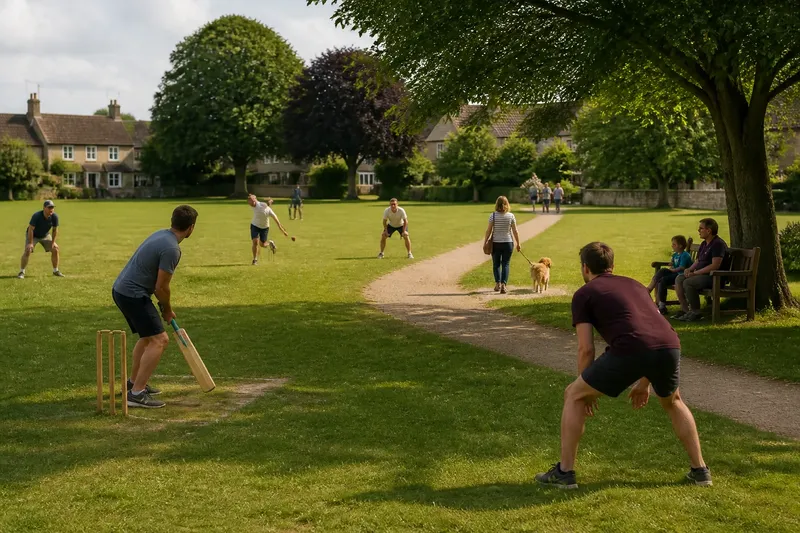
A village green boundary is rarely just the line where grass meets a hedge. A footpath, a worn strip beside a bench or the edge of a cricket square can each mark a different limit, and informal games often respond to all of them. The useful question is not where the green ends on a map, but which boundary matters to the game being played.
Which boundary counts during a game?
There is no single answer. Players may treat one edge as out of bounds, use another to define a target, and ignore a third because people regularly cross it. On a shared green, the working boundary is the one that makes play understandable while leaving other users a clear route through.
That distinction matters because land boundaries and playing boundaries serve different purposes. A hedge may mark the edge of the village green, while a path running through it remains a route for walkers. A game can occupy the grass beside the path without claiming the path itself. Likewise, a tree line might define a loose fielding limit without marking any formal property line.
Before play begins, look at how people already use the space. Notice where walkers enter and leave, where dog walkers tend to cross, and whether benches or a noticeboard draw people to one side. These patterns tell players which edges can be used for play and which need to remain open.
How do paths affect where players stand?
Paths divide a green without necessarily dividing it into separate playing areas. A broad, busy route may need to stay clear, while a quieter path can sit beside play if players can see people approaching and pause when needed. The route’s position matters as much as its width: a path crossing between a bowler and batter is different from one running along the back of a fielding area.
Players can arrange themselves so that the route sits outside the main direction of play. For a casual bat-and-ball game, the batter might face away from a well-used path, with fielders spread across the open grass rather than stationed where passers-by are likely to walk. In a game of rounders, a base may need to shift so that runners do not cut across the route.
This does not mean treating every passer-by as an obstacle to be managed. It means leaving room for people to use a shared place without needing to negotiate through a live game. A simple pause when someone approaches can be more practical than trying to claim a large, fixed playing area.
What makes an edge useful for informal play?
An edge is useful when it gives players a clear reference point without creating a nuisance for other users. A low hedge can help players recognise a side of the playing area. A row of trees may provide a visible limit for fielders. A bench can mark a convenient meeting point, but it is not a suitable target if people are sitting nearby.
Edges also differ in how predictable they are. A wall or fence is easy to see, but a ball rebounding from it can head towards people or a road. Long grass may signal that a ball has travelled beyond the useful playing area, yet it can make the ball hard to find. A sloping verge may look like spare space until a rolling ball draws players towards a path.
Choose an edge by asking what happens when the game reaches it. If players can retrieve a ball without crossing a busy route or disturbing a gathering, the edge may work. If the boundary repeatedly sends players into a bottleneck, move the playing area or change the direction of play.
How can a shared green accommodate different games?
Different games need different shapes, and a village green may not offer an uninterrupted rectangle. A game with a central target can fit into an open patch; a running game needs room for people to move between points; a kicking game may need a clear direction that keeps the ball away from a path. The green can support more than one arrangement without making any of them permanent.
Think in terms of a playing patch rather than a complete pitch. Players can use a cluster of trees as a visual end, leave the middle path untouched, and use a second patch when another group arrives. This approach suits informal play because boundaries can shift as the number of players, visitors and available space changes.
Say a group arrives for a casual cricket game and finds walkers using the central path and a family sitting near one side. The players could set a short, informal playing area on the quieter grass, face the batter towards the open centre, and agree that a ball reaching the path pauses play. The observable result should be a game that can stop cleanly for passing walkers without requiring them to detour or the group to claim the whole green.
Where two games overlap, agree which parts are active and which remain shared. A boundary can be a line players respect rather than a physical marker. If people cannot see or remember the arrangement, use a simple explanation before play rather than placing equipment where it could obstruct a path.
What should players agree before they start?
A brief conversation prevents confusion later. The aim is not to write formal rules for a casual game, but to settle the points that affect other users and the flow of play.
- Playing area: Point out the patch of grass in use, then leave a visible route for walkers.
- Out-of-bounds edge: Choose a recognisable limit, such as the tree line, rather than a vague stretch of open grass.
- Paths and crossings: Agree where play pauses when someone needs to pass through.
- Ball retrieval: Decide who retrieves a ball that travels beyond the playing patch, especially if it approaches a hedge or road.
- Shared objects: Keep benches, gates and gathering points clear instead of turning them into targets or bases.
- Changing conditions: Be ready to move or reshape the game if another group needs the space.
Keep the agreement proportionate. A small group playing a gentle game may need only a clear starting point and a shared understanding about the path. A larger group moving quickly may need more open space and a firmer limit. It is not worth marking every edge with cones or debating an exact line when a short verbal agreement would do.
Do village greens have formal boundaries for games?
Usually, the practical playing boundary is agreed by the people using the space rather than supplied as a standard layout. A green’s paths, grass, trees and facilities vary, so a boundary that works for one game or one village may not suit another. Treat informal arrangements as local decisions, not a universal rule.
Can a game use a path as part of its boundary?
A path can be a visible reference, but it should remain usable by people passing through. Players might agree that a ball touching the path is out, or pause play while someone crosses; they should not assume that a route belongs to the game. The clearest choice depends on how busy the path is and how the game moves.
Should players use cones or other markers?
Markers can help when a boundary is hard to explain, provided they are easy to see and do not obstruct routes or create trip hazards. In many casual games, a tree, hedge or agreed line is enough. Avoid leaving equipment behind or placing markers where other green users need to walk.
What if another group arrives?
Pause and agree how the open space can be shared before either group settles into a fixed arrangement. One game may shift to a quieter patch, or both groups may use separate areas with a clear route between them. If the space is too busy for safe, comfortable play, choose a different time or place.
Why does the boundary change with the season?
Ground conditions and patterns of use can alter which edges are practical. Wet grass may make a sloping corner unsuitable; longer vegetation can hide a ball; a path may become busier during a village event. A familiar layout is a starting point, not an obligation to play in the same place every time.
For a village green, boundaries work best as shared cues rather than claims of ownership. Notice the routes people use, choose edges that make the game legible, and leave room to adjust when the green changes around you. That is the point of treating a village green boundary as more than one line: it lets play fit the place, rather than asking the place to fit a pitch.